
The Dent Argument Most Couples Have (and Who's Usually Right)
Here's the mistake almost everyone makes first: treating a garage door dent like a car door dent. One spouse grabs a plunger, a heat gun, or a YouTube tutorial and tries to pop it back out. The other says leave it alone, it's just cosmetic. Both are tempting positions because a garage door looks like one big flat metal panel, the same way a car fender does, and the internet is full of satisfying videos of dents popping back into shape in seconds.
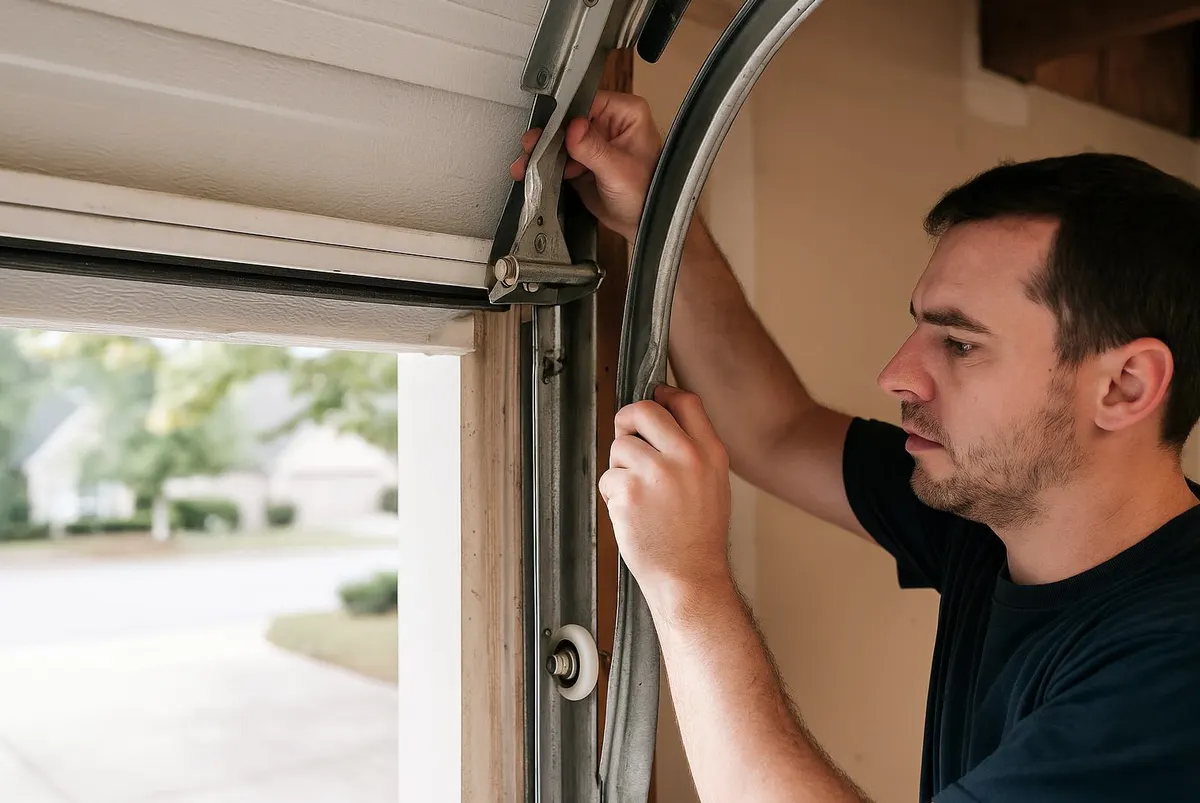
The problem is a garage door is not a car panel. It is a moving structural assembly with hinges, rollers, tracks, and reinforcement that all have to line up and flex correctly every single time the door opens and closes. A dent in the wrong spot is not a cosmetic issue, it is a mechanical one. The trick is knowing which kind you're looking at before anyone picks a side.
Dents That Usually Can Be Repaired
- Small, shallow dents in the middle of a panel, away from edges, hinges, and the center where the opener arm attaches. On thicker-gauge steel doors these can sometimes be massaged back out or filled and repainted.
- Dents from a minor bump (a bike, a trash can, a mirror on a wide truck) that didn't crease the metal, just bowed it.
- Cosmetic dents on a sectional door where only one panel is affected. Many sectional doors allow a single panel to be replaced without swapping the whole door, which keeps the repair affordable.
Dents That Usually Cannot Be Repaired
- Dents with a sharp crease or fold instead of a smooth bowl shape. Once steel creases, the metal has stretched and weakened at that line. Pushing it back doesn't restore the strength, it just hides the problem until the next hit.
- Dents in aluminum doors. Aluminum doesn't flex and spring back the way steel does. Trying to pull it out usually cracks or thins the metal further.
- Dents that span a seam between panels or sit right along the edge of a panel (the stile or rail). These edges are where hinges and rollers attach, so a dent here throws off alignment even if it looks minor.
- Dents on insulated doors that have pushed the front skin into the back skin. You'll often see this as a slight warp or a spot where the insulation has separated, and it's not something paint and filler fix.
When a Dent Is Actually Structural
A dent crosses from cosmetic to structural when it affects how the door moves or how it holds up under load. Signs to take seriously:
- The door binds, scrapes, or hesitates at the exact spot where the dent is.
- The dent is on or near an end stile, hinge bracket, or roller bracket.
- The dent is on the bottom panel where the horizontal wind-load reinforcement strut runs. Doors in this part of Alabama are often built or retrofitted to meet wind-load requirements for hurricane-season gusts, and a dented or buckled strut area can mean the door no longer resists wind pressure the way it's supposed to.
- You can see daylight, gaps, or uneven spacing around the dented section when the door is closed.
A Quick Test You Can Run Before You Argue About It
- With the door closed, run your hand along the dent. A smooth dip means likely cosmetic. A sharp line or ridge means likely structural.
- Open and close the door slowly, watching the dented panel. If it flexes, pops, or catches, that's mechanical, not cosmetic.
- Check if the dent lines up with a hinge, roller bracket, or the reinforcement strut. If it does, assume structural until someone qualified says otherwise.
- Look for cracked paint or exposed bare metal at the dent. That's your next concern, even if the dent itself turns out to be minor.
Why Humidity and Storm Season Make This Call Different Here
A dent that's purely cosmetic in a dry climate doesn't stay cosmetic for long around here. Cracked paint at a dent exposes bare steel to the humidity and afternoon downpours common in this part of Alabama, and rust starts fast once moisture gets into a scratch or crease. A small dent you ignore in October can be a rust spot by spring, and rust weakens metal in exactly the areas you need strong when wind-load matters during hurricane season. If you're going to leave a dent alone, at minimum touch up the paint to seal the metal.
When to Call Warrior Garage Door Works
If the dent is near a hinge, roller, or the bottom reinforcement strut, or if the door is binding, scraping, or not sitting flush when closed, that's the point to stop debating and get it looked at. We handle this with straightforward Garage Door Repair for panel replacement and alignment work, and if the dent has also thrown off the door's balance or strained the springs, we'll check that as part of the visit rather than send you a surprise second bill. For doors where rust has already set in around an old dent, sometimes a full panel swap through our Garage Door Installation service is the more honest long-term answer than another patch job.
If you're in Warrior, Kimberly, Morris, Hayden, Trafford, Blountsville, Gardendale, or Locust Fork and you need a local garage door repair call to settle the debate once and for all, reach out to Warrior Garage Door Works. We'll tell you straight whether it's a touch-up or a real repair, and get it handled right.